Top 5 Mistakes Companies Make in Employment Agreement with ESOPs

HR Legal Experts

Looking for clarity on how ESOPs actually fit into an employment agreement in India?

You’re not alone. Many business owners and startup founders are eager to reward employees with company shares but often overlook how those promises should appear in their contracts. A small legal gap today can turn into a big business issue tomorrow.

At HR Legal Experts, we’ve seen growing companies across India face legal and cultural confusion because of unclear ESOP clauses. The reason? Most teams focus on the reward, not the rules.

In this article, we’ll break down what an employment agreement with ESOP means, why it’s more than just a line in your offer letter, and the five most common mistakes companies make when drafting it, along with practical ways to fix them.

What is an employment agreement with ESOP in India?

Let’s start simple.

An employment agreement with ESOP (Employee Stock Ownership Plan) is a work contract that doesn’t just define an employee’s job or salary. It also outlines how they can earn part ownership in the company through shares or stock options.

In India, ESOPs are a popular way for startups and growth companies to attract and retain key talent without paying huge upfront salaries. The “ownership” is given in stages, known as vesting, based on how long the employee stays and performs.

Think of it as a reward for long-term commitment, but one that comes with specific legal terms and timelines.

That’s where things often go wrong.

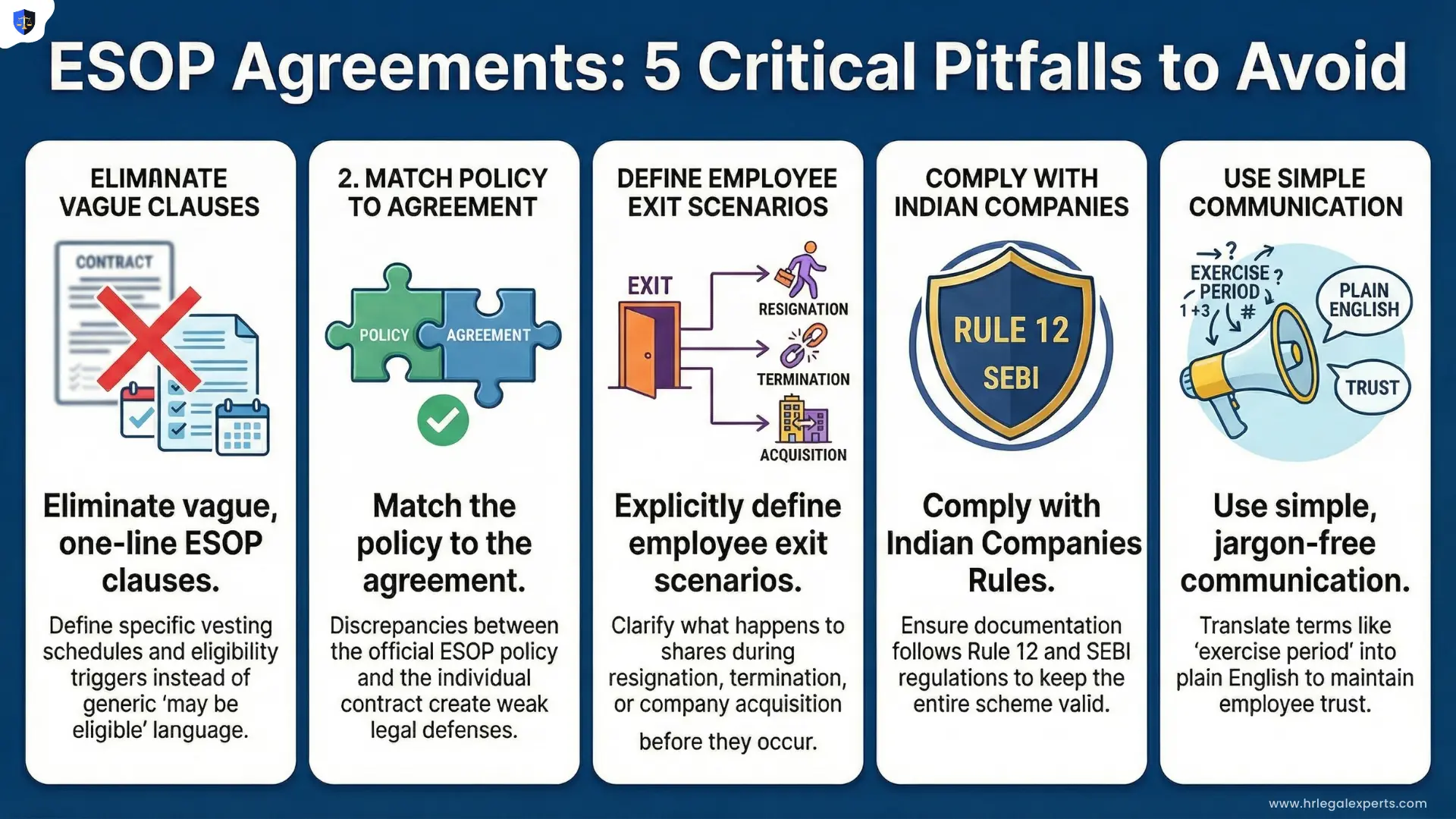
1) Treating the ESOP clause as an afterthought

Many companies include just one vague line about ESOPs in their employment contracts:

“The employee may be eligible for stock options as per company policy.”

That’s a legal gray area waiting to happen.

Without details about when shares vest, what happens if an employee resigns early, or how the options are priced, both sides can interpret it differently. And that’s where disputes start.

Our insight: Treat your ESOP clause as a contract within a contract. Define eligibility, vesting schedule, and trigger events clearly. Make the clause self-contained or link it to an annexure that’s referenced within the agreement.

At HR Legal Experts, we always say: “Clarity today prevents conflict tomorrow.”

2) Not matching the ESOP policy and the employment agreement

Another big mistake is when a company’s official ESOP policy and the individual employment agreement don’t match. 

One document says “vesting every 12 months,” the other says “quarterly.” One defines a “cliff period,” the other doesn’t. 

Inconsistencies like these confuse employees and weaken your legal defense if a dispute arises. 

Our insight: Your policy and your employment agreement must speak the same language.

ESOP Agreements 5 Critical Pitfalls to Avoid - HR Legal Experts

3) Ignoring what happens when an employee leaves

What happens to ESOPs if an employee quits before completing their vesting period?

Or worse, what if they’re terminated?

Most companies don’t include those scenarios at all, leaving HR and finance to handle the fallout later. 

Some end up revoking shares unfairly, while others allow benefits they never intended to.

Our insight: Define what happens when someone leaves: voluntary resignation, termination, retirement, or company acquisition.

Transparency here protects both employer and employee, and it also signals fairness to the rest of the team.

4) Forgetting legal compliance in India

Many growing startups borrow ESOP templates from global playbooks, which usually do not work well in India.

In India, ESOPs are regulated under Rule 12 of the Companies (Share Capital and Debentures) Rules, 2014, and SEBI’s Share-Based Employee Benefit Regulations, 2021 for listed companies.

Missing out on board approval, proper documentation, or shareholder consent can make the entire ESOP scheme invalid.

Our insight: Indian ESOPs aren’t just about motivation; they’re about method.

5) Failing to communicate in simple language

Even when ESOPs are legally correct, they often fail communication.

Employees get letters full of legal terms like grant dateexercise periodfair market value, and no one really explains what those mean.

That’s where trust breaks down.

Our insight: A good employment agreement should be readable by everyone, not just the legal department.

Closing note

ESOPs are one of the best tools to reward loyalty and build long-term teams, but only when they’re legally sound.

A vague employment agreement may save you time today, but it can cost you trust (and sometimes equity) tomorrow.

That’s why at HR Legal Experts, we help businesses build agreements that work like promises.

Need help fixing or drafting your ESOP-linked employment agreements?

Let’s make your legal clarity your next competitive edge.

Contact HR Legal Experts, your partner in simplifying corporate law and HR compliance in India.

Frequently Asked Questions

1) Is ESOP mandatory in an employment agreement in India?

No. ESOPs are optional, but if offered, they must be clearly documented in both the employment agreement and ESOP policy.

2) Can ESOP clauses override the company ESOP policy?

No. The employment agreement must align with the officially approved ESOP scheme.

3) Are ESOPs regulated in India?

Yes. ESOPs are governed under Rule 12 of the Companies (Share Capital and Debentures) Rules, 2014 and SEBI regulations for listed companies.

4) What happens to ESOPs if an employee resigns?

Unvested options typically lapse. Vested options may be exercisable within a defined period depending on company policy.

5) Should ESOP terms be in simple language?

Yes. Clarity prevents disputes and strengthens employee trust.