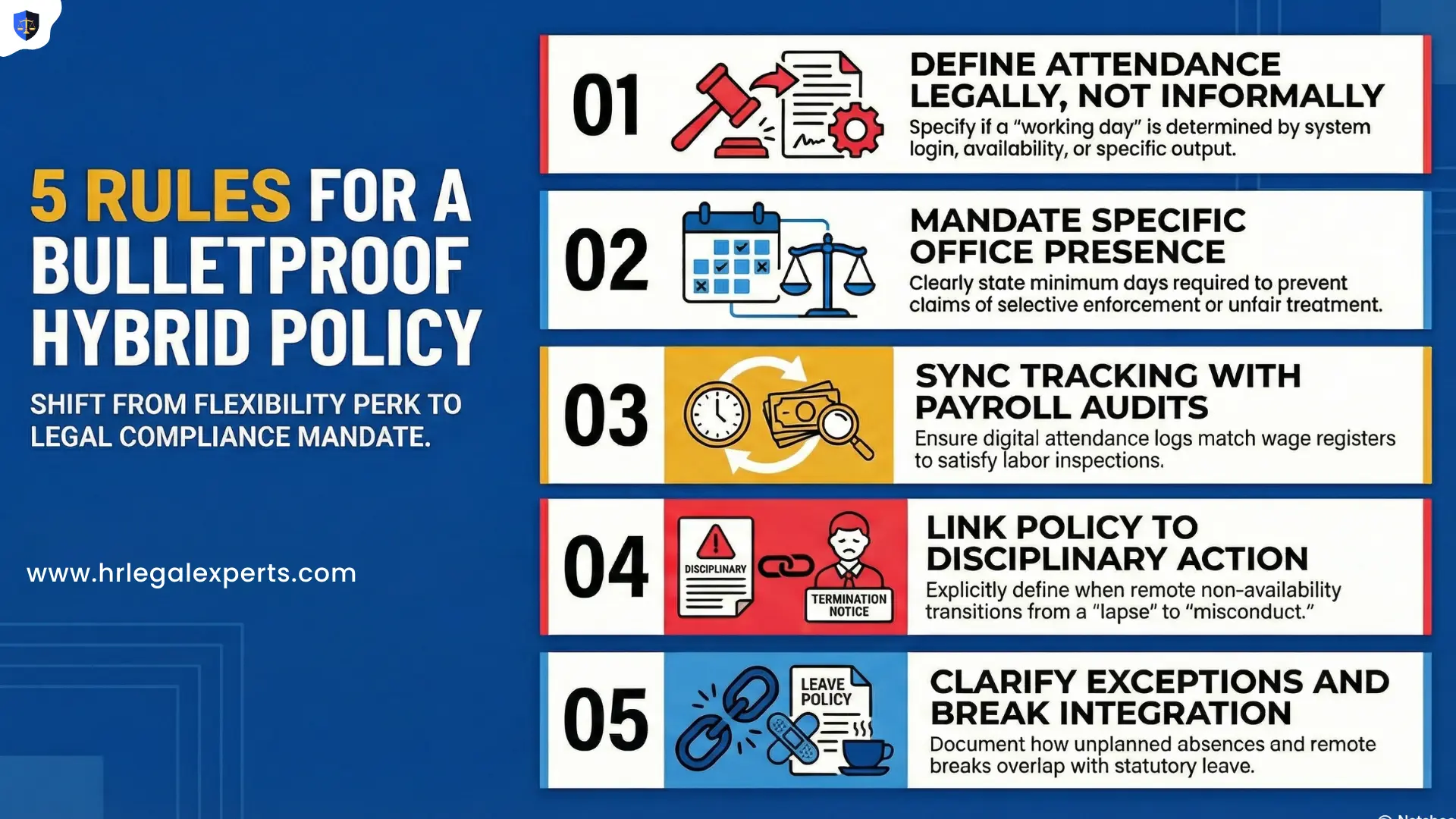
5 Hybrid Attendance Policy Rules for Compliance

HR Legal Experts

A poorly drafted hybrid attendance policy is now a recurring trigger in employment disputes across India. As companies shift to hybrid and remote work models, attendance expectations are increasingly questioned during audits, payroll reconciliations, and even termination disputes.

In recent HR compliance reviews across IT, consulting, and services sectors, attendance-related ambiguity has featured in a majority of employee grievances involving hybrid roles, particularly salary deductions and unauthorised absence. The problem is rarely intent. It is usually documentation.

This article explains five hybrid attendance policy rules that Indian companies must clearly define to avoid disputes, ensure payroll accuracy, and remain legally defensible.

1. Define attendance legally, not informally

A hybrid attendance policy must define attendance in legal and operational terms, not managerial assumptions.

In India, attendance directly impacts:

• wage eligibility under the Payment of Wages framework

• leave accrual under applicable Shops and Establishments Acts

• disciplinary action for unauthorised absence

Your policy should clearly define:

• what constitutes a working day in a hybrid setup

• whether login, availability, or output determines attendance

• how partial attendance is treated

In disputes, courts and labour authorities rely on written policy, not internal understanding. Where attendance definitions are missing, employer action becomes difficult to justify, particularly during wage deduction or termination challenges.

2. Specify office presence to avoid selective enforcement

Hybrid work does not mean optional office attendance unless stated.

A legally sound hybrid attendance policy must specify:

• minimum office days per week or month

• whether office attendance is role-based or universal

• who approves deviations

In internal grievance cases, inconsistent enforcement of office presence has led to claims of unfair treatment. Clear written rules prevent selective application and internal conflict.

3. Attendance tracking must align with payroll and audits

Attendance tracking is not just an HR tool. It is a payroll and compliance record.

Indian employers face issues when:

• attendance data does not match payroll

• salary deductions are made without documented absence

• overtime or extra hours are claimed without policy backing

Your hybrid attendance policy should state: 

• the official attendance tracking method

• how remote work hours are recorded

• how discrepancies are resolved

In labour inspections, attendance logs are often reviewed alongside wage registers. Mismatch raises red flags.

For organisations formalising these records, a work-from-home and hybrid attendance policy template helps align attendance, payroll, and compliance documentation. 

👉 Access the hybrid attendance policy template 

5 rules for a hybrid policy compliance - hrlegalexperts

4. Link attendance rules to disciplinary action carefully

One of the most common legal mistakes is disciplining employees without linking attendance rules to misconduct definitions. 

A compliant hybrid attendance policy should clarify: 

• when absence becomes unauthorised

• whether repeated non-availability is misconduct

• how warnings or disciplinary steps apply

In termination disputes reviewed internally, employers frequently lost credibility where attendance violations were enforced without a defined policy basis. Clear linkage strengthens the employer’s legal position.

5. Define exceptions, breaks, and leave integration

Hybrid attendance disputes often arise around exceptions, not routine workdays. 

Your policy must clearly explain: 

• how breaks are treated during remote work

• how leave overlaps with hybrid schedules

• how emergency or unplanned absence is reported

In termination disputes reviewed internally, employers frequently lost credibility where attendance violations were enforced without a defined policy basis. Clear linkage strengthens the employer’s legal position.

Why hybrid attendance policies are under legal scrutiny

Hybrid work blurred boundaries. Compliance has sharpened them. 

Labour authorities now expect:

• written attendance definitions

• consistency across remote and office staff

• traceable records supporting payroll 

A weak hybrid attendance policy increases exposure during inspections, internal complaints, and exits.

Conclusion

A hybrid attendance policy is no longer a flexibility document. It is a compliance document. 

When attendance rules are clearly defined, consistently enforced, and aligned with payroll and discipline processes, companies reduce disputes and protect operational control. 

👉 Download a legally aligned hybrid attendance policy template 


Frequently Asked Questions

1. What is a hybrid attendance policy in India?

It defines how attendance is recorded for employees working partly remotely and partly from the office.

2. Can salary be deducted for remote attendance issues?

Only if absence is documented and policy-backed.

3. Is office attendance mandatory in hybrid models?

Only if clearly stated in the attendance policy.

4. Do labour inspectors review attendance policies?

Yes. Attendance and payroll records are often reviewed together.

5. Can attendance rules differ by role?

Yes, if differences are documented and applied consistently.